
By now you’ve come in contact with the acronym SEO.
It stands for “Search Engine Optimization” and is “the process of affecting the visibility of a website or a web page in a search engine’s unpaid results”. In other words, it means how well your site shows up on a search engine result page when someone organically searches for something.
But what does this mean for YOU and your business? Is it something you should spend money on? Is it something you need to worry about? Is it something you can have an impact on?
Every day there are more than 2.2 million searches on just Google. The more people that visit a website, the more traffic that page has. Traffic is good, unlike what most of us think of as we are sitting in our cars getting frustrated by the car not moving in front of us. Traffic is important for a business as it is visibility, and more importantly, traffic can contain users who can be converted to customers.
Most search engine traffic comes from Google, but it can vary by industry and niche. The algorithm used is complex, but it works by looking for answers to the user question that contain quality and relevant information, usually based on keywords. It is also driven by connection: if your page is linked to more trusted and frequented sites, it gets a boost. If users frequently stay on your site that is also a boost (versus going back to the search page to see other results). If the page loads quickly and works well on a mobile device: boost. These are only a handful of the factors that impact SEO, but they are big ones. Focus on your business page to include keywords users will actually be searching for and distinguish you from your competition.
Moz, an SEO and marketing site, perhaps said it best in their introduction guide to SEO. They use the concept and imagery of the famous Maslow’s Hierarchy of Needs pyramid to create their own “Mozlow” SEO pyramid. From the most important base to the least important top in the SEO world:
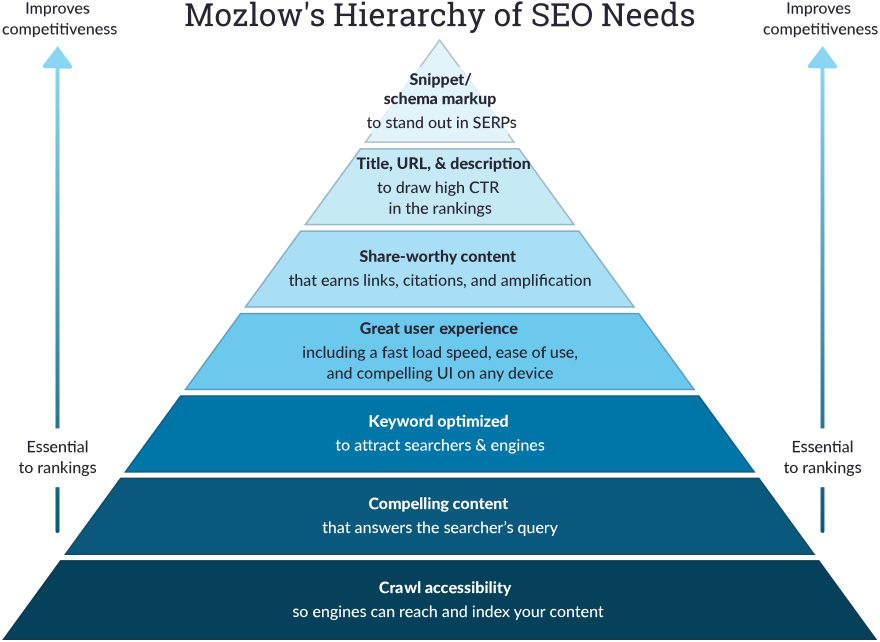
- search engine friendly (crawling)
- quality content
- keyword optimization
- user experience (speed, ease)
- sharing and share-worthy-ness
- Titles, URL and descriptions, and finally the top is number
- snippet/schema markup.
The same principle applies to both hierarchies, that the base of the pyramid has to be in place in order for the rest to be built on top successfully. So it’s likely, when starting your journey with SEO for your business, you’ll want to start at the base of the pyramid and work your way up over time.
Do you know how to check what people are searching for within your site? Do you have access to your own website (if not that’s a bigger problem that needs to be addressed). There are tools you can use on your own site to analyze how your key terms are doing in their search volume, and adapt accordingly. It’s also important to consider the quality of your site’s source code, and determine if search engines will be able to crawl your site properly, gathering relevant data.
Don’t know how? Let us help you! There are thousands of ways to improve your visibility, traffic, and searchability, and we can start where you need it most.
Demers, Tom. “SEO Basics: Complete Beginner’s Guide to Search Engine Optimization.” WordStream, https://www.wordstream.com/blog/ws/2015/04/30/seo-basics.
Patel, Niel. SEO Made Simple: A Step-by-Step Guide for 2019. https://neilpatel.com/what-is-seo/.
The Beginner's Guide to SEO. Moz, https://moz.com/beginners-guide-to-seo.